Toeing the Beltline

09/12/2016

It looked like every seat was full in the chapel at the Carter Center on March 16, 2016 as Ryan Gravel, the original mind behind the Beltline, took the stage for a conversation on his new book “Where We Want to Live.” Atlanta’s crown prince of urban infrastructure seemed at ease as the conversation with WABE’s Valerie Jackson weaved through a narrative of Gravel’s reflections and instructions on how to best navigate the major social shifts affecting the formula for a thriving 21st century city.

Although Jackson made a few polite suggestions of causes for concern vis-a-vis the current style of development occurring along the Beltline, the general feel was celebratory and congratulatory. After the talk ended, a long line formed to get books signed, and the murmurs from the predominately middle-aged, European-American crowd fell along the lines of “great speech,” and “really great speech.” The choir was well satisfied.

In the nearly hour-long discussion filled with platitudes about controlling sprawl, creating walkable spaces, and the value of public transit, perhaps the most telling moment was an anecdote Gravel related about a favorite photo he took encapsulating his idea of the Beltline ethos. Out for a weekend bike ride on the Eastside trail with his children, Gravel paused to capture them enjoying the fruits of his labor. It was only later, Gravel related, while scrolling back through his photos that he noticed something in the background of the image that solidified the value of the project: “a red-haired woman, pushing a load of groceries back home.”

If the moment was loaded with poignancy, it was amplified in my mind by the steadily growing evidence that the read-haired woman is by far the exception, and not the rule. As a daily commuter on the Eastside trail since its earliest days, the most shocking observation has not been its self-evident success, but its low-key lack of fulfillment of so many of its most idealistic promises. In essence, it often seems less a link between diverse communities, less an encourager of bike or walk commuting, less a useful benefit to pre-existing residents, and more a glorified dog park, more an open air gym for recently-arrived residents, more a place to see and be seen. Particularly as the days warm out of winter, the throngs of ear-budded joggers, casual after-work chatters, and dog walkers circulate in stark contrast to the relative emptiness just weeks before, when a much smaller subset of committed exercisers dotted the path on chillier afternoons.

So far, the Beltline’s Eastside trail can easily be seen as serving much the same role as the acclaimed Highline in New York City, a project to which it is often compared (and which ironically graces the cover of Gravel’s book.) They both serve as a brilliant repurposing of unused infrastructure, a great place for a relaxing stroll, a compelling draw for tourists, but of no outstanding utility to the original community.

In no way should this be construed as an attack on Gravel’s vision or efforts to see them through. By all accounts he has been nothing less than a tireless advocate for the bold and innovative project, a project’s that greatest benefit, if early impacts are any indication, might ultimately be the addition of much needed new park space. As a consistent user of the Eastside trail, any critique comes foremost from a place of gratitude, for the opportunity to enjoy 2.25 miles of car-free travel. But it also comes with the understanding that for all the lofty sense of achievement, a fair dose of cynicism is appropriate. It is only in our best interest to constantly and closely scrutinize the true impact of a project with as much potential as this one.

Which is why, for such a crucial moment, the feel of the interview seemed somewhat complacent. At this point, who’s to say the whole Beltline won’t follow the pattern of the Eastside trail? That it won’t all become a corridor of luxury, high-end apartments and up-scale retail? Gravel has made repeated suggestions in the last few years that the Beltline cannot be considered a success until transit becomes a part of it. But in light of the 2016 General Assembly’s last minute rush to save any effort for MARTA expansion legislation, the “shift” that Gravel mentioned so often throughout the night has taken on arguably a different meaning in Atlanta.

In a city that under eight years of Reed administration has been very business-friendly, you don’t have to look hard to see how the Beltline is being co-opted by everyone from big developers to medium-sized house-flippers to a full array of real estate speculators and landlords. Listings, ads and banners that wrap the fences of new developments promise the “Beltline lifestyle,” currently little more than marketing jargon in long-underserved areas of southeast, southwest and northwest Atlanta. In neighborhoods that realtors, businesses, even grocery stores, wanted little or nothing to do with for decades (often the result of long-standing, racist policies) they’re now flocking to to buy out remaining, cash-strapped tenants.

After making the rounds though a crowd of familiar faces following the speech, well known community activist Angel Poventud admitted a sense of anxiety about the rising home prices in his neighborhood of Adair Park, which recently saw its first sale over $200k. Just 5 years ago, Poventud bought a dilapidated Craftsman for $15,000. Now similar houses are asking four and five times that.

Of course, all this Belline-spurred development wouldn’t be such a problem if it weren’t for its impact on the existing communities. Study after study has revealed a decline in Atlanta’s once renowned affordable housing and reports of displaced residents are mounting. As slow as the Beltline’s progress has seemed to many, it has still managed to outpace the city’s ability to restructure zoning laws or put any substantive affordable housing protections in place.

So what is “the Beltline lifestyle?” For now, for many, it means access to a very wide, very smooth sidewalk. And it’s that admission that brought about the only flash of irony that punctuated the evening. The final question of a short Q&A came from a bubbly GA Tech student, who pointed out that the Beltline’s value is at least in part offset by the decrepit conditions of so many of the sidewalks that feed into it. Gravel chuckled, “Atlanta does have a special problem with sidewalks.”
Time to rethink private events in public parks

Like so many big music festivals these days, this past weekend’s Shaky Knees Festival had an impressive lineup. The headliners were some of the biggest bands of the last 20 years, plus a slew of other rock and alternative acts with loyal followings. When the lineup was first released, my interest was piqued; I’m still kicking myself for missing The Strokes at Music Midtown in 2004.

Shaky Knees’ rapid rise over the last three years from the Masquerade Music Park to Atlantic Station to this year’s three-day takeover of Old Fourth Ward’s Central Park has likely been welcomed by many, especially those currently enmeshed in the zeitgeist scene of #festivallife.

But in the weeks leading up to the event, as I debated getting a ticket, the more I envisioned enjoying some of my favorite bands with the skyline as a backdrop, the more I couldn’t ignore the dark cloud of another growing trend: a disturbing disregard for the “public” part in public parks, a bend towards privatization and profiteering that’s at odds with almost everything these cherished spaces are meant to represent.

To be clear, I’m not against concerts being held in parks. Much to the contrary, I appreciate that they are a beloved and time-honored tradition: later this May, the Atlanta Jazz Festival is celebrating its 38th year in Piedmont Park. And in the last 20 years there have been plenty of successful alternative shows around town: On the Bricks at Centennial Olympic Park, earlier Sweetwater 420 Fests at Candler Park, and 99x Downtown Rocks at Underground Atlanta.

The one thing all those concerts had in common? Their price tag: free and open to any one who wandered in.

The fact is, whether free or not, big concerts always come with a few costs: inevitable traffic congestion in the surrounding neighborhoods and wear-and-tear on the site.

Wear-and-tear has taken the spotlight of late after the disastrous timing of record rains and an estimated 70,000 people in Centennial Olympic Park for last month’s ticketed Sweetwater 420 Festival. The mud churned up was calf deep and the park will be a maze of barricades for the better part of the next month, with the majority of the former lawn areas cordoned off as the grass re-establishes itself.

It’s important to note that Centennial is actually not managed by the city but is under the control of the Georgia World Congress Center Authority, a state agency. A park spokeswoman informed me that private events are a crucial part of the park’s revenue. The GWCCA is attempting to have the park operate at a self-sustaining level. Its budget is higher than the average park given the cost of operating the Olympic fountain and other water features, she said.

In City of Atlanta parks, event organizers are responsible for 100 percent of the clean-up and remediation of parkspaces. But the remediation process, as noted, can vary from a few days to well over a month.

The pertinent issue, however, for the state and city alike is the rising frequency with which the public must not only accept those aforementioned inconveniences while also being denied access to their own taxpayer-funded resources.

Last summer, in a two-week period, major private events dominated the space at arguably Atlanta’s two premier parks: first Music Midtown in Piedmont Park and then the OutKast #ATLast shows in Centennial, which snowballed from a planned single Saturday night into a three day mini-festival extravaganza.

I boycotted Music Midtown on principle for disrupting the most pleasant part of my daily commute. The event staff working in the days leading up to the concert were remarkably inhospitable, acting as if I and other park users were inconveniencing them for using the roads in the park as they barreled around in forklifts and carts.

But I felt strongly compelled to attend what promised to be the greatest homecoming a city could possibly muster. Despite my nagging irritation that Outkast had decided to charge their most loyal supporters and neighbors, the concert did not disappoint. The energy was so captivating that some friends and I returned the following night just to take in the scene. After circling the chain-linked enclosure for an opportune spot I was momentarily in eyeshot of the stage. Then a guard approached: “Hey! You gotta move.”

“Why?”

“You can’t be there.”

We ended up watching from the top of a parking deck, a bird’s eye view into the last place I would want to see one of the metro area’s original sins: a gated community.

According to the Trust for Public Land’s ParkScore index, Atlanta ranks 42nd out of the top 60 biggest U.S. cities for how well the city is meeting its need for parks. Only 5.8 percent of the city area is parkland, compared to percentages 3 or 4 times higher for cities in the top 10 like Minneapolis, Portland, and New York. To some, this may come as a surprise given Atlanta’s reputation as a city with a dense green canopy. But the truth is Atlanta is woefully underserved when it comes to parks and city leaders should show some action where that statistic is concerned (continuously plugging the Beltline does not count.)

To begin with, given our lack of park space, the city should impose a ban on large-scale, ticketed events in existing public parks. If city government is so keen on hosting these events and reaping the revenue they provide, they need to devote new and designated parkland for it.

Along Northside Drive alone, there are two large empty tracts of land within a couple miles of each other, one just north of Ikea — the parcel was last reported as eyed for development — and another just north of the GWCC parking lots on Ivan Allen Jr. Boulevard — the site of the demolished Herndon Homes. There are similar plots scattered throughout the city, including the most obvious candidate for a Chastain-on-steroids addition: the Old Atlanta Prison Farm.

The selection of Central Park (along with Renaissance Park and the parking lots behind the Civic Center) for Shaky Knees typifies the inherent injustice of selectively closing public spaces, particularly in a rapidly changing city. Central Park is small, just 17 acres, and largely used by people living in close proximity. Most people I’ve encountered who live more than a couple miles away are unaware Atlanta even had a Central Park, or that it was formerly Bedford-Pine Park. The park anchors the corner of an area of the Old Fourth Ward that contains the highest amount of subsidized housing in the Southeast. It is an area that has long suffered from the underinvestment typical in low-income urban areas.

It is also in the heart of an area that has undergone some of the most extreme redevelopment in the city in the last 20 years, with surging rent prices spurred by numerous large developments of upscale apartments. Councilman Kwanza Hall, whose district includes the festival footprint said he’s “not sure that the [site selection] says very much” about the changing demographics of the area.

But in a city becoming more and more known for its wealth disparity, there’s something a little off-putting about the extravagance of a private 3-day festival butting up to the front doors of the working poor.

Politicians in general (and city mayors in particular) love to play up their appreciation for public spaces. Constantly referring to them in endearing clichés like “jewels of the city” and frequently citing them as the single best attraction for both tourists and locals alike, it’s impossible to disagree. So what does it mean if even for a few days, any random visitor, passer-by or daily user can no longer freely enjoy the city’s greatest gift?

[An edited version of this piece was published by Creative Loafing Atlanta: http://clatl.com/atlanta/time-to-rethink-private-events-in-public-parks/Content?oid=14291961]

STILL FEELING CHOPPED: What the Braves move continues to say about pride, prejudice, the past, and progress

4/2/2014

A few weeks ago I received an unexpected phone call: “Hey, this is [Jeff] with the Atlanta Braves. Is this Nick?”

“Uh…yeah.”

For an instant, as my friendly caller took a breath and as a rush of unsettled, bitterly suppressed feelings flooded my head, the audacious, improbable thought that somehow this call was in regard to my last piece or the desperate feelings of betrayal I’d been casually sharing with (or showering on) anyone who would listen flicked across my mind; I mean, the Braves had never called me before

Continue reading

AND THEY’RE OUT! On the Braves escape to the ‘burbs

November 11, 2013

Every summer of my life I have enjoyed a particular ritual that occurs without warning on those quintessential balmy Southern Friday nights. I have heard it from open car windows, as the dank, sticky air rushes past outstretched hands, from front and back porches, where the buzz of mosquitoes and chirping crickets approaches a deafening din, and, when I was little, on certain devious nights when I snuck out, from my tree house, in a pecan tree in our backyard in West End.

It is a jolting crack through the night — a brief pause of stillness — and then a boom, then snaps and bangs and reports. It is explosions over Summerhill. It is Friday night fireworks at Turner Field, home of the Braves.

Continue reading

Stacking the decks

11/9/14

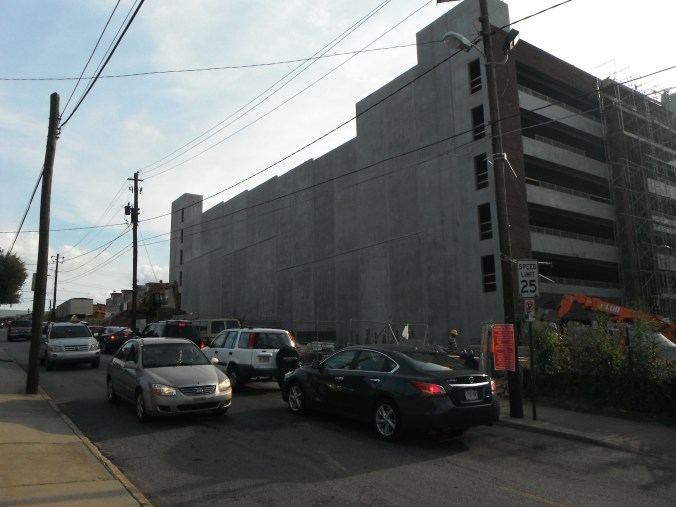
If you’ve been on Krog Street in the past few months, then you probably haven’t missed the monolithic block of concrete that has risen in a former parking lot between Edgewood Ave and the Stoveyard complex. While initially catching my eye for its striking resemblance to the Israel-West Bank border wall, it has, over the last few weeks, transitioned from one massive wall into a full four-sided structure, yet another new multi-story parking deck built to house some indubitably impressive amount of vehicles, assuming they can find a way in.

Continue reading